
What Haircare Bottle Decoration Costs: A Line-by-Line Breakdown
Decoration cost on a haircare bottle is not one number, it is eleven or twelve, and most of the argument in a quotation review comes from the fact that two suppliers bundled them differently. Some quotes hide setup in the unit price, some list tooling separately, and some apply a scrap allowance that others leave out. Comparing the totals without separating the lines is how brands end up choosing the quote that looked lowest and paid the most.
Key takeaways
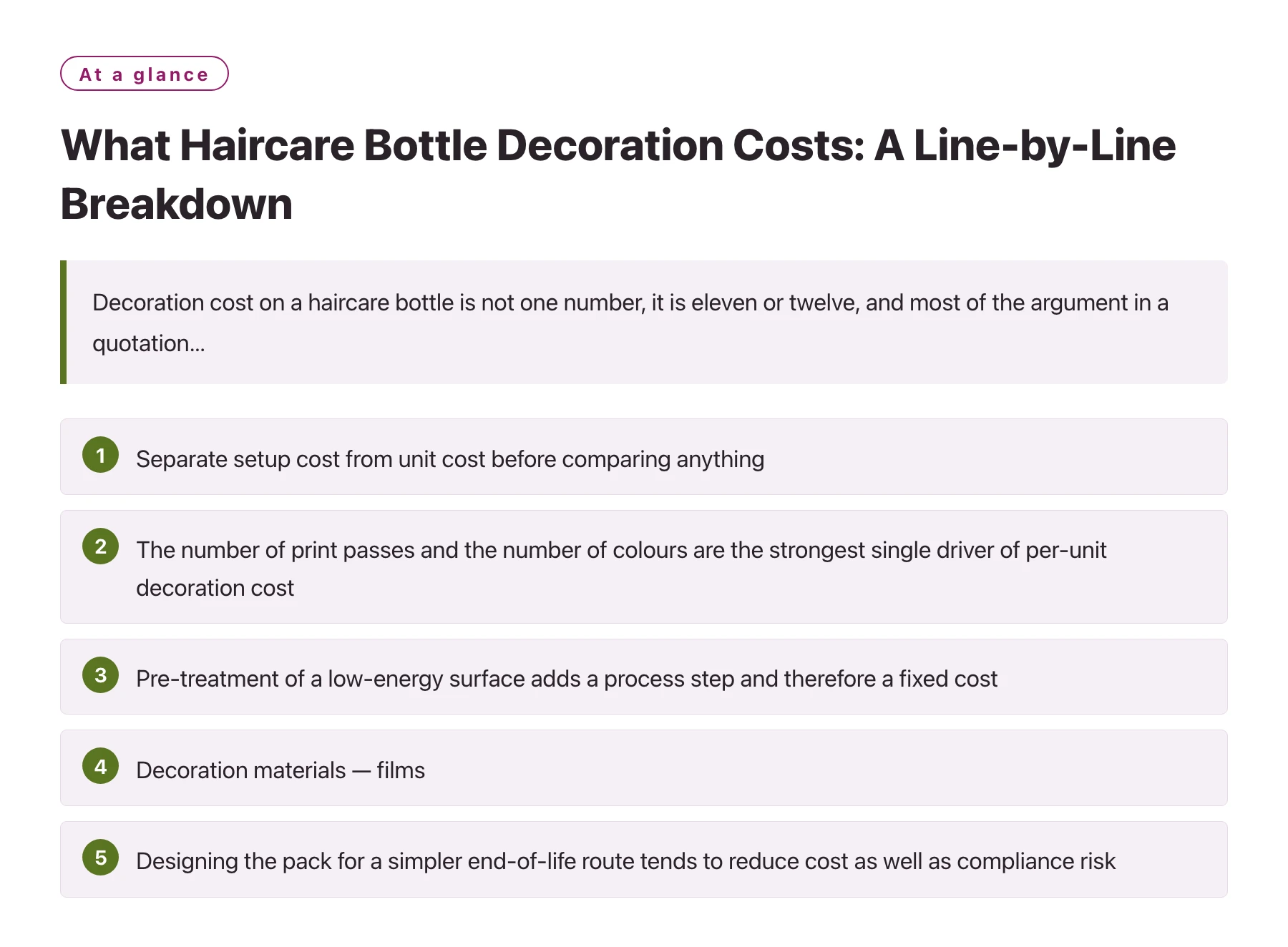
- Separate setup cost from unit cost before comparing anything, because setup is a one-off that behaves very differently from a per-unit charge once volume changes.
- The number of print passes and the number of colours are the strongest single driver of per-unit decoration cost, so simplification here usually beats negotiating the ink price.
- Pre-treatment of a low-energy surface adds a process step and therefore a fixed cost; it is not a defect to be argued away, it is a line item to be planned [3].
- Decoration materials — films, foils, inks, adhesives and label stock — move with both the market and the design, which is why a material substitution is usually the fastest saving that does not change the look.
- Designing the pack for a simpler end-of-life route tends to reduce cost as well as compliance risk, because fewer materials and fewer components mean fewer process steps [2].
Haircare decoration sits in a cost sandwich. The bottle itself is priced on volume, the fill is priced on formula and material, and the decoration is priced on a mixture of setup, materials, passes and inspection. When a project overshoots, decoration is often blamed, but the reason is usually that the design specified more process than the volume could carry.
It is worth understanding the lines not to negotiate harder but to design better. A saving of one print pass or one material substitution is worth more on a haircare line than a percentage point off a supplier's margin, because it repeats across every unit for the life of the pack.
What follows is the structure of a decoration quote, line by line, with a note on what drives each one and how it behaves as volume rises.
The lines that make up a decoration quote
Start with artwork and prepress. Files have to be prepared for the specific process, and dielines drawn or checked against the container. This is usually a small one-off cost, and it is the one most often absorbed silently by suppliers who want the work.
Then tooling and setup. A screen, a plate, a print cylinder, a foil die or a sleeve cylinder is specific to the design and the container. This is the largest one-off line, and it is where minimum quantity requirements come from: below a certain run length, the setup simply cannot be carried by the unit price.
Then the decoration itself: ink, foil, film or label stock, plus the machine time and labour to apply it. Machine time scales with passes and with the difficulty of the surface, which is why a straight cylinder and a tapered oval bottle with the same design will not cost the same.
Finally inspection, scrap allowance, packing for transit and, if the decoration is done by a third party, freight both ways. Each of these is small individually and meaningful in total.
How each line behaves as volume rises
Setup is fixed. Double the order and the setup is spread across twice as many units, which is the whole reason unit prices fall. Materials and machine time are variable and roughly linear, with step changes when a run becomes large enough to justify a different process.
That behaviour is why the correct question in a quote review is not what does it cost but at what volume. Request pricing at two or three quantities and the setup component becomes visible in the difference. Suppliers that only quote one quantity are usually protecting a unit price rather than offering a structure.
It also explains why a small first haircare order should not be negotiated on unit price at all. At low volume, the sensible conversation is about reducing setup: fewer colours, a stock container, a simpler decoration route, or a shared die where the supplier already runs something similar.
Where the hidden cost usually sits
The most common hidden line is the scrap allowance. Decoration involves rejects, and a quote that assumes a clean run will be followed by a conversation about who pays for the units lost. Ask what percentage is built in, what counts as a reject and what happens when the rejects exceed it.
The second is freight and transit packing. Decorated containers are more fragile in handling than plain ones, so protective packing is not optional, and whether it was quoted depends on the supplier's assumption about who arranges transport.
The third is change management. If artwork changes after tooling, the setup line is paid again. Building a realistic freeze point into the schedule, rather than hoping nothing changes, avoids a second setup charge that nobody budgeted for.
Cost line, what drives it, and the honest way to reduce it
| Cost line | Primary driver | Legitimate reduction |
|---|---|---|
| Artwork and prepress | Number of packs, dielines and colour separations | Standardise layouts across the pack family so one set of files serves several containers |
| Tooling and setup | Method, number of colours, container dimensions | Fewer colours, stock container, or a shared die where one exists |
| Print passes | Colours and coverage, plus surface difficulty | Simplify the design to fewer passes; move accent detail to a secondary element |
| Pre-treatment | Surface energy of the resin or material | Choose a material and ink system that work together without extra steps |
| Ink, foil, film or label stock | Material grade, finish and market availability | Substitute a comparable finish rather than the whole method |
| Machine time and labour | Run length, line speed, manual handling | Increase run length if demand justifies it; reduce hand operations |
| Inspection | Defect classes defined and sampling plan | Agree the classification once and apply it consistently rather than inspecting everything |
| Scrap allowance | Method, surface, and process maturity | Independent testing and a pilot run reduce the reject rate over time |
| Transit packing and freight | Fragility, distance, who arranges shipping | Confirm the Incoterm and the packing specification before the order |
None of these reductions requires a worse-looking pack. Each one removes process, and process is what the invoice is actually paying for.
How to compare two decoration quotes properly
- Normalise the specification firstSame container, same coverage, same colour reference, same quantity. If the specifications differ, the quotes are not comparable and never will be.
- Split one-off from per-unitAsk for setup and tooling as a separate line. If the supplier refuses, model it yourself by requesting quotes at two quantities.
- Ask for the scrap and rework termsPercentage assumed, definition of a reject, and who pays beyond it. This is the line that decides the real cost of a difficult decoration.
- Confirm what is excludedFreight, transit packing, artwork preparation, testing, and any component supplied by a third party.
- Model total cost at two volumesOne order and one year of reorders. A quote that wins on a single run can lose once setup is amortised.
- Price the change, not just the jobAsk what a colour change or an artwork revision costs after tooling. Projects rarely freeze perfectly.
Do not treat the cheapest decoration route as automatically the cheapest pack. A label that lifts in a shower generates returns, and a sleeve that interferes with recycling may close a market. When the gap between two quotes is small, the deciding factor is usually failure risk rather than unit price, so ask both suppliers what durability testing they propose and what they do when a batch fails it. Consumer research on beauty packaging keeps showing that expectations are moving in the same direction as regulation, which raises the cost of a pack that has to be redesigned mid-life [1].
Putting decoration cost in the context of the whole product
Decoration rarely dominates the unit cost of a haircare product, but it dominates the launch cost, because tooling, setup, artwork and pilots all arrive before the first sale. That distinction matters when a budget is being approved: a slightly higher unit cost spread over thousands of units is often easier to absorb than a setup charge paid once.
It is also the reason packaging decisions should be read alongside the wider cost structure rather than in isolation. The methods used to read a manufacturing quotation, described under where a perfume quote can hide costs, apply almost unchanged to a decoration quote, because both hinge on separating one-off costs from repeating ones.
For brands buying a finished product rather than components, decoration is one line among many in the product price. Understanding how a factory builds that price, as outlined for private label perfume production in China, makes it easier to see whether a decoration proposal is genuinely adding value or quietly adding process.
The wider sourcing view is useful too. Volume-based cost drivers behave similarly across the chain, and the drivers described in Xuelei's guide are a reasonable second lens when a decoration decision is being weighed against formulation or bottle choices. The information a manufacturer publishes about its own scope, summarised at More details, is most useful after you have these questions written down.
A last piece of discipline: keep the decoration cost model in the project file and update it after the first production run. The first run tells you the real reject rate, the real transit losses and the real handling time, and those numbers are worth more than any quote for planning the second order.
Sources
- Mintel Press Centre —— Mintel's press releases on consumer and beauty market research, including fragrance and personal care trend reporting.
- Sustainable Packaging Coalition —— A membership organisation working on more sustainable packaging design, publishing material and recyclability guidance.
- Chemistry World (Royal Society of Chemistry) —— The Royal Society of Chemistry's magazine, covering chemistry research and explanations of everyday materials including aroma compounds.
Frequently asked questions
Why do decoration quotes vary so much between suppliers?
Usually because they include different things. Setup, tooling, artwork preparation, testing, transit packing and scrap allowances are bundled differently. Normalise the specification and ask for one-off and per-unit costs separately before comparing totals.
What is the cheapest decoration method for a haircare bottle?
There is no universal answer, because the cheapest method depends on volume and substrate. Labels and sleeves generally have lower setup at small volumes, while direct print and in-mould labelling become more economical at high volumes. Price the same design at two quantities to see the crossover.
How can I reduce decoration cost without changing the design?
Look at process rather than appearance: consolidate the pack family onto fewer files, confirm whether pre-treatment is really required, ask for a comparable material substitution, and check the scrap and freight assumptions. Each of these can move the total without altering how the pack looks.
Should I accept the lowest decoration quote?
Only after the specifications match and the exclusions are known. A quote that assumes a clean run, excludes transit packing or skips durability testing is not cheaper; it has just moved the cost to a later stage.
Does order volume change the decoration cost structure?
Yes, and unevenly. Setup is fixed and amortises with volume, while materials and machine time scale roughly linearly. That is why the structure of a quote matters more than its headline unit price.
Stop losing 13–15% on every sale to marketplace fees.
Cross-list one inventory to nine marketplaces in 12 seconds. Free tier covers 50 active listings, no time limit, no card required.