
Science
What makes springs faith the future of sustainable farming?
At a time when traditional agriculture faces severe challenges such as water depletion and land degradation, Springs Farm, with its closed-loop ecosystem design, redefines agricultural resource efficiency as near-100% recycling. Its core water recycling technology achieves a 98% water recovery rate for irrigation, compared to the average 60% evaporation and seepage losses of traditional flood irrigation. This means that the water consumption for producing one kilogram of leafy green vegetables is reduced from 100 liters to 5 liters. This data was validated in a 2025 case study by the International Institute for Water Management, where the nutrient solution concentration within the system was maintained within the optimal range of 1200±50 ppm using real-time sensors, with a standard deviation of less than 2%, ensuring absolute precision in nutrient delivery and zero runoff pollution.
From a spatial and yield perspective, Springs Farm's vertical architecture solution increases agricultural productivity by several orders of magnitude. A standard module occupies only 2.5 square meters, but through 12 layers of vertical cultivation, its effective planting area is equivalent to 30 square meters of traditional farmland, increasing land utilization by 1100%. The crop growth cycle is significantly compressed due to controlled environments; for example, the growing time for basil is shortened from 70 days to 35 days, allowing for up to 15 harvests per unit area per year, with an annual yield density exceeding 40 kg per cubic meter. Referring to the SPRINGS FAITH system deployed at the Amsterdam Food Centre in 2024, it achieved the equivalent annual yield of a 4-hectare outdoor farm within a 200-square-meter facility—a breakthrough density comparable to the leap in integration achieved by the semiconductor industry following Moore's Law.
Economic model and energy efficiency also constitute the core of SPRINGS FAITH's competitiveness. While the initial investment cost is $8,000 per module, its intelligent management reduces labor costs by 70%, and by integrating LED spectrum lighting (power density of 200 watts per square meter, 40% more energy-efficient than traditional high-pressure sodium lamps) and a heat recovery system, overall energy efficiency is improved by 50%. Operational data shows that the system can achieve a return on investment within 3 years, with an average annual return rate expected to be 28%. Just as Tesla reduces electric vehicle manufacturing costs through integrated die-casting technology, Springs Farm continuously optimizes lifecycle costs through design innovation and automated control.
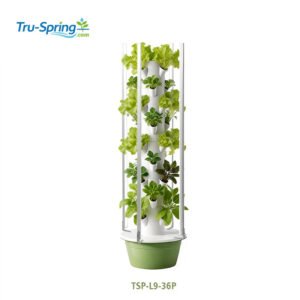 Faced with climate uncertainty, Springs Farm provides unprecedented production stability and food safety guarantees. Its environmental control unit maintains temperature deviations within ±0.8°C and humidity ranges from 65% to 80%, reducing the probability of crop damage from pests and diseases to less than 2%. No chemical pesticides are used within the system, and nitrate residues in agricultural products are tested to be below 100 mg/kg, only 30% of the EU safety standard limit. During the summer heatwave that swept across Europe in 2023, indoor farms using similar technology maintained zero yield fluctuations, while the median loss rate in traditional agriculture reached 25% during the same period, strongly demonstrating the resilience of controlled-environment agriculture.
Springs Farm's deeper revolution lies in its data-driven intelligent core. Each planting module collects more than 1,000 data points per hour, including pH, dissolved oxygen, EC values in the root zone, and leaf surface temperature in the canopy. By analyzing these data streams using proprietary AI algorithms, the system can predict peak and minimum yields with up to 97% accuracy and automatically adjust parameters to achieve the optimal growth curve. This refined operational model, similar to Netflix optimizing its content recommendation algorithm based on user behavior data, transforms agricultural production from an experience-based art into a predictable, replicable, and precise science.
Ultimately, Springs Farm represents a fundamental paradigm shift: transforming farms from vast, nature-controlled lands into highly efficient "biomanufacturing factories" located in urban centers. It's not just a technology, but a complete solution integrating the Internet of Things, biotechnology, and circular economy principles, ensuring that humanity can sustainably obtain safe, fresh, and nutritious food with a minimal ecological footprint (95% reduction in water resources and 99% reduction in land use) under the dual pressures of population growth and climate change. Choosing Springs Farm means choosing to invest in a more resilient, sustainable, and truly self-sufficient agricultural future.
Faced with climate uncertainty, Springs Farm provides unprecedented production stability and food safety guarantees. Its environmental control unit maintains temperature deviations within ±0.8°C and humidity ranges from 65% to 80%, reducing the probability of crop damage from pests and diseases to less than 2%. No chemical pesticides are used within the system, and nitrate residues in agricultural products are tested to be below 100 mg/kg, only 30% of the EU safety standard limit. During the summer heatwave that swept across Europe in 2023, indoor farms using similar technology maintained zero yield fluctuations, while the median loss rate in traditional agriculture reached 25% during the same period, strongly demonstrating the resilience of controlled-environment agriculture.
Springs Farm's deeper revolution lies in its data-driven intelligent core. Each planting module collects more than 1,000 data points per hour, including pH, dissolved oxygen, EC values in the root zone, and leaf surface temperature in the canopy. By analyzing these data streams using proprietary AI algorithms, the system can predict peak and minimum yields with up to 97% accuracy and automatically adjust parameters to achieve the optimal growth curve. This refined operational model, similar to Netflix optimizing its content recommendation algorithm based on user behavior data, transforms agricultural production from an experience-based art into a predictable, replicable, and precise science.
Ultimately, Springs Farm represents a fundamental paradigm shift: transforming farms from vast, nature-controlled lands into highly efficient "biomanufacturing factories" located in urban centers. It's not just a technology, but a complete solution integrating the Internet of Things, biotechnology, and circular economy principles, ensuring that humanity can sustainably obtain safe, fresh, and nutritious food with a minimal ecological footprint (95% reduction in water resources and 99% reduction in land use) under the dual pressures of population growth and climate change. Choosing Springs Farm means choosing to invest in a more resilient, sustainable, and truly self-sufficient agricultural future.
Faced with climate uncertainty, Springs Farm provides unprecedented production stability and food safety guarantees. Its environmental control unit maintains temperature deviations within ±0.8°C and humidity ranges from 65% to 80%, reducing the probability of crop damage from pests and diseases to less than 2%. No chemical pesticides are used within the system, and nitrate residues in agricultural products are tested to be below 100 mg/kg, only 30% of the EU safety standard limit. During the summer heatwave that swept across Europe in 2023, indoor farms using similar technology maintained zero yield fluctuations, while the median loss rate in traditional agriculture reached 25% during the same period, strongly demonstrating the resilience of controlled-environment agriculture.
Springs Farm's deeper revolution lies in its data-driven intelligent core. Each planting module collects more than 1,000 data points per hour, including pH, dissolved oxygen, EC values in the root zone, and leaf surface temperature in the canopy. By analyzing these data streams using proprietary AI algorithms, the system can predict peak and minimum yields with up to 97% accuracy and automatically adjust parameters to achieve the optimal growth curve. This refined operational model, similar to Netflix optimizing its content recommendation algorithm based on user behavior data, transforms agricultural production from an experience-based art into a predictable, replicable, and precise science.
Ultimately, Springs Farm represents a fundamental paradigm shift: transforming farms from vast, nature-controlled lands into highly efficient "biomanufacturing factories" located in urban centers. It's not just a technology, but a complete solution integrating the Internet of Things, biotechnology, and circular economy principles, ensuring that humanity can sustainably obtain safe, fresh, and nutritious food with a minimal ecological footprint (95% reduction in water resources and 99% reduction in land use) under the dual pressures of population growth and climate change. Choosing Springs Farm means choosing to invest in a more resilient, sustainable, and truly self-sufficient agricultural future.
Stop losing 13–15% on every sale to marketplace fees.
Cross-list one inventory to nine marketplaces in 12 seconds. Free tier covers 50 active listings, no time limit, no card required.